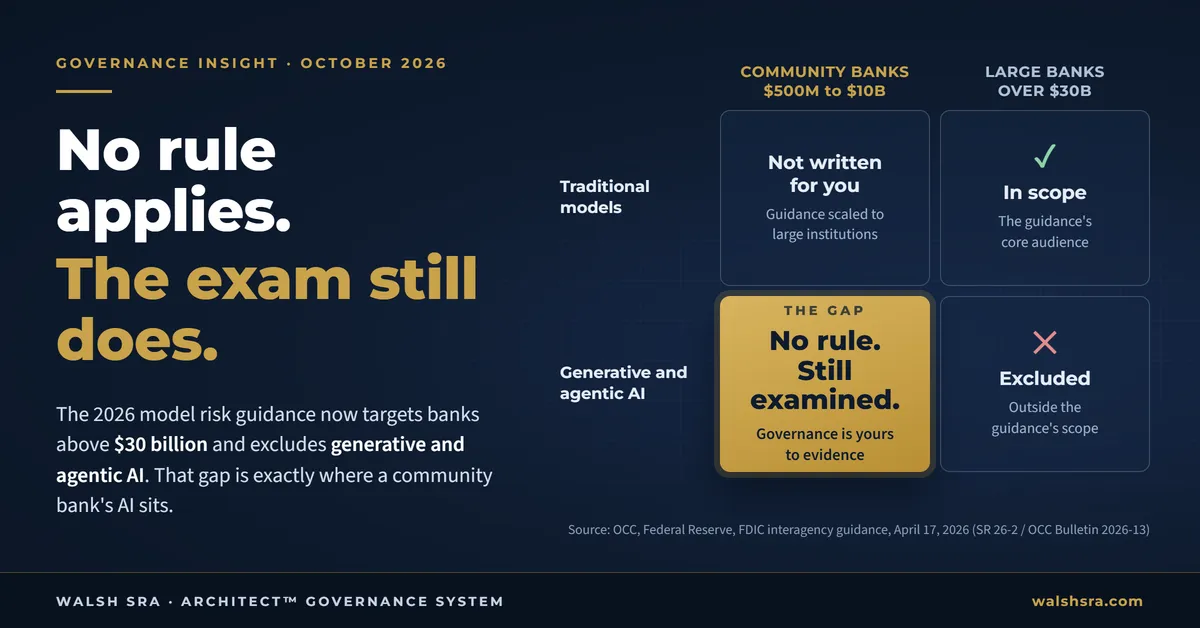
No Rule Applies. The Exam Still Does.
TL;DR
The April 2026 interagency model risk guidance raised the asset threshold that matters to $30 billion and excluded generative and agentic AI from its scope entirely, exactly the technology nearly every community bank is actually running. That is not relief, it is a gap with no federal rulebook attached to it. A real incident this year, an unauthorized AI tool exposing customer data at a Pennsylvania community bank, shows what happens when that gap goes unmanaged. The standard a $500 million to $10 billion institution actually needs to meet is proportionate and achievable: name an owner, know what you are running, assess it by real risk, and be able to show your work. Waiting for the next rulemaking cycle is not a strategy. The exam, the breach, or the buyer will find the gap first.
The guidance that wasn’t written for you
On April 17, 2026, the OCC, the Federal Reserve, and the FDIC jointly replaced the model risk management framework that has governed banking since 2011. Two changes in that rewrite matter more to a community bank than anything else in it.
First, the agencies raised the asset threshold for who the guidance is “most relevant to” from $1 billion to $30 billion. A bank with $500 million, or $2 billion, or $8 billion in assets is no longer the institution this guidance was written to describe.
Second, and more consequentially, the new guidance explicitly excludes generative and agentic AI from its scope. The agencies call these tools “novel and rapidly evolving” and decline to extend model risk principles to them at all. Traditional statistical models still count. The chatbot your loan officers use to draft correspondence, the AI feature your core processor rolled into last quarter’s software update, the summarization tool your compliance team adopted to save time on exam prep: none of it is covered.
Put those two changes together and the implication is specific, not general. The guidance most community banks might have leaned on for AI oversight was narrowed past them on one axis and emptied out on the other. For the kind of AI a $500 million to $10 billion bank is actually running today, there is no federal rulebook with your name on it. That is not the same thing as no exposure. It means the exposure is now entirely a function of what your own board can show, not what a regulator wrote down for you to follow.
Where the exposure actually sits
Three distinct pain points show up in the data, and they compound rather than sit side by side.
Vendor-embedded AI nobody decided to adopt. The core banking market is concentrated: Fiserv, FIS, and Jack Henry together serve more than 70 percent of U.S. banks, per Federal Reserve Bank of Kansas City research, with Jack Henry and Fiserv specifically dominant among smaller institutions. Switching costs are real: 61 percent of banks in a 2022 ABA survey had worked with their core provider for more than a decade. When Wolf & Company surveyed community banks on AI adoption in early 2026, 30 percent reported their AI use was limited entirely to ad hoc or vendor-embedded features, meaning AI capability that arrived bundled inside a core platform update rather than through any deliberate evaluation. For roughly a third of this segment, nobody in the building actually decided to adopt AI. It showed up in a release note.
Generative AI with no visibility behind it. In the same Wolf & Company survey, 95 percent of respondents are actively exploring or investing in AI employee productivity tools such as Copilot, the highest use case by far, well ahead of fraud and compliance support at 45 percent. That is generative AI: drafting, summarizing, researching, the exact category the new federal guidance just excluded from scope. Only 15 percent of respondents said implementing AI governance and usage policies was a current priority, and 35 percent named a lack of governance or operating model as an active challenge.
A policy nobody can verify against a list of what staff are actually running is not governance. It is paperwork.
Confidence that has outrun control. This is the pain point most boards do not see coming. Ninety percent of respondents in the Wolf & Company survey expressed some degree of confidence in the governance of their internal and third-party AI tools. Set against that: only 5 percent have reached a scaled, governed AI program, and not a single institution surveyed named vendor or third-party AI risk as its top priority, despite 40 percent citing it as a genuine concern. Confidence is not evidence. A board that feels reasonably sure its AI is under control, without a named owner, a usage inventory, or a documented review trail to back that feeling up, is holding exactly the gap an examiner or a plaintiff’s attorney is trained to find.
What this looks like when it breaks
This is not hypothetical. On May 5, 2026, CB Financial Services Inc., the holding company for Community Bank in Pennsylvania, discovered that an employee had used an unauthorized AI tool to access non-public customer information, including names, dates of birth, and Social Security numbers. The bank determined the incident was material on May 7 and filed a Form 8-K under Item 1.05, the SEC’s rule for material cybersecurity incidents, on May 11, inside the required four-business-day window. At least one class-action threat followed.
Nothing about this incident required a large institution, a sophisticated attacker, or a novel technology. It required one employee, one unauthorized tool, and an institution that could not see what was happening before a regulator and a plaintiff’s bar could. Shadow AI typically inherits whatever access the employee who adopted it already had, which is often far broader than the tool itself needs. An institution that cannot govern what it cannot see is not protected by its size. If anything, a community bank’s leaner compliance function means fewer people positioned to catch this kind of use before it becomes a filing.
The implications
Examiner exposure arrives now, not after the next rulemaking cycle. On September 16, 2026, the Conference of State Bank Supervisors gave state examiners an AI Supervisory Framework that reaches generative and agentic AI directly: the category the federal guidance set aside. Examiners using it may ask for AI policies, an inventory of AI systems and use cases, risk assessments, vendor documentation and evidence of monitoring. The framework is discretionary; each state decides how far to adopt it, and it applies to state-chartered banks, while nationally chartered banks remain under OCC supervision. The direction is clear all the same, and none of it waits for a federal AI rule. A written policy that cannot be backed by an inventory and a review trail will not satisfy an examiner working from this framework.
Fair lending and consumer protection exposure does not depend on whether a model is in scope of MRM guidance. Equal Credit Opportunity Act and Regulation B obligations around adverse action notices apply to any credit decision influenced by an algorithm, AI-labeled or not, regardless of what the 2026 model risk framework does or does not cover. The exclusion of generative and agentic AI from MRM scope is a statement about model validation expectations. It is not a statement that fair lending law has gone quiet.
Vendor lock-in compounds all of it. A bank that cannot easily leave its core provider inherits whatever AI features that provider ships, on that provider’s schedule, often without a renegotiated contract covering model behavior, version changes, or audit rights. Governance obligations arrive bundled with a system the bank cannot walk away from in any reasonable timeframe.
Consolidation is turning this into a due diligence line item. Community bank M&A has not slowed, and acquirers are increasingly applying the same operational and compliance diligence to AI exposure that they have applied for several years to BSA/AML and cybersecurity posture. A target bank that can produce a current AI inventory, a named governance owner, and a documented review trail will move through diligence differently than one that cannot. This is the same pattern this series has already traced in private equity and asset management: a governance gap that starts as a compliance question ends up as a pricing and timeline question at the exact moment a deal is most sensitive to both.
Proportionality cuts both ways
None of this argues for a community bank to build the AI governance infrastructure of a $200 billion regional. The CSBS framework is explicitly designed to account for an institution’s size, complexity, risk profile and actual use of AI. In practice, that points toward a proportionate standard: an inventory sized to what the bank actually runs, and ownership placed in a committee that already exists, such as an IT Steering or Information Security Committee, rather than new structures built for their own sake.
That cuts in a useful direction for a board trying to decide how much is enough. The standard being applied is not “match the infrastructure of a $30 billion bank.” It is “name an owner, know what you are running, assess it by actual risk, and be able to show your work.” That is a proportionate, achievable standard for an institution at this scale, and it is considerably less expensive to build than the absence of it is to discover during an exam, a breach, or a sale.
What a governance assessment actually finds at this scale
Picture a composite, but entirely typical, community bank. Call it representative rather than real: roughly $2 billion in assets, a single state charter, a core system from one of the three dominant providers, no dedicated technology risk function, and an IT Steering Committee that meets quarterly.
Run the same six-pillar diagnostic this series has applied to larger institutions, and the findings look remarkably consistent, just smaller in scale and faster to fix.
Accountability. No one can name a single person accountable for AI across the institution. The IT Steering Committee reviews vendor updates as they arrive, but its charter predates AI entirely and was never amended to name an owner for it.
Risk Integration. AI sits outside the principal risk taxonomy. It is handled as a technology procurement matter, reviewed for cost and uptime, never assessed for credit, consumer protection, or reputational risk.
Capital Exposure. Nobody has translated what an AI failure would actually cost. A fraud-detection feature embedded in the core platform was recently retuned by the vendor without notice, and no one at the bank can say whether that changed the institution’s false-positive or false-negative rate, or what that would mean in dollar terms.
Horizon Scanning. No one on the committee was aware that the April 2026 interagency guidance excluded generative AI from scope. The institution did not know it was operating in a gap; it assumed the absence of a specific rule meant the absence of exposure.
Information and Reporting. The board’s most recent AI-related briefing was a vendor’s security attestation letter, forwarded without comment. There is no internal inventory of AI use, approved or unapproved, anywhere in the institution.
Transparency and Defensibility. Asked to produce documentation of a single reviewed AI-assisted decision, whether a credit decision, a fraud alert override, or an approved use of a generative tool, the institution has nothing to hand over. Use is happening. None of it has left a record.
None of these findings require a large remediation program. Naming an owner is a board resolution. Building a usage inventory, including vendor-embedded features, is a structured discovery exercise measured in weeks, not months. Folding AI oversight into the existing IT Steering Committee’s charter, rather than creating a new body, is exactly what the proportionality principle above calls for. Mapping the institution’s actual AI use against materiality, so the board spends its attention on the handful of uses that touch credit, fraud, and customer disclosure rather than treating every tool as equally urgent, is the single highest-leverage step in the whole exercise.
What changes is not the size of the bank. What changes is whether the next exam, the next vendor contract renewal, or the next acquirer’s diligence team finds a named owner and a defensible record, or finds exactly what CB Financial Services discovered the hard way: that the gap was already there, and nobody had looked.
Before the next board meeting
Four questions are worth putting on the agenda, in plain language, before the next scheduled board or committee meeting.
The inventory question. Could we produce, today, a list of every AI tool in use across this institution, including features embedded in our core platform, without a week of scrambling to assemble it?
The ownership question. If an examiner asked who owns AI governance here, would three people in the room give the same name?
The vendor question. Do we know what changed the last time our core provider updated an AI-enabled feature, and whether anyone reviewed that change before it went live?
The evidence question. Could we show documented review of one specific AI-assisted decision, not a policy that allows for review, proof that it happened?
If any of those four produces hesitation, the gap this piece describes is not a future risk. It is the present state of the institution, waiting for an examiner, a breach, or a buyer to find it first.
Not sure whether your institution’s AI use would hold up under the kind of examiner questions already showing up in routine third-party and information security reviews? The ARCHITECT™ AI Governance Assessment for Community Banks is a fixed-scope, fixed-fee diagnostic sized to what a community bank actually needs, not a scaled-down version of a program built for a $30 billion institution. It starts with a short conversation.
Author bio
Brendan Walsh is the founder of Walsh SRA and creator of the ARCHITECT™ Governance System. He brings more than 30 years of global executive leadership at American Express across the US, Europe and Asia, including as Chairman of American Express Services Europe and American Express Bank Russia. He has served as a Board Advisor to OFGEM, the UK energy regulator, and as a Board Member of the ECB's Euro Retail Payments Board. He holds a Harvard Master's in Sustainability and GARP certifications in Sustainability & Climate Risk and AI Risk. Walsh SRA advises mid-tier banks, insurers, asset managers and private equity firms on governance for climate, sustainability and AI risk.
