The Label Is Not the Governance: Why Asset Management Oversight Has Entered a New Era
TL;DR
For mid-tier asset managers, sustainability has moved from a labelling exercise to a governance test. The firms that hold up under scrutiny will not be the ones with the cleanest fund names. They will be the ones that can show, from their own records, how a name, a label, and a stewardship commitment are actually governed inside the investment process.
The real test for asset managers is no longer whether a fund is named correctly. It is whether the firm can prove the name was earned, and can keep proving it every quarter the fund stays open.
From disclosure to defensibility
For most of the last five years, sustainability in asset management has been a labelling and disclosure exercise. Classify the fund. Report the principal adverse impact indicators. Publish the pre-contractual disclosure. Update the periodic report. Answer the ESG questionnaire that comes with every institutional mandate review. Most serious mid-tier managers built this capability competently, hired sustainability specialists, licensed ESG data, and produced disclosure documents that satisfy the letter of SFDR, the UK's SDR regime, or the US Names Rule.
That phase is ending, and the market has already run the experiment that proves it.
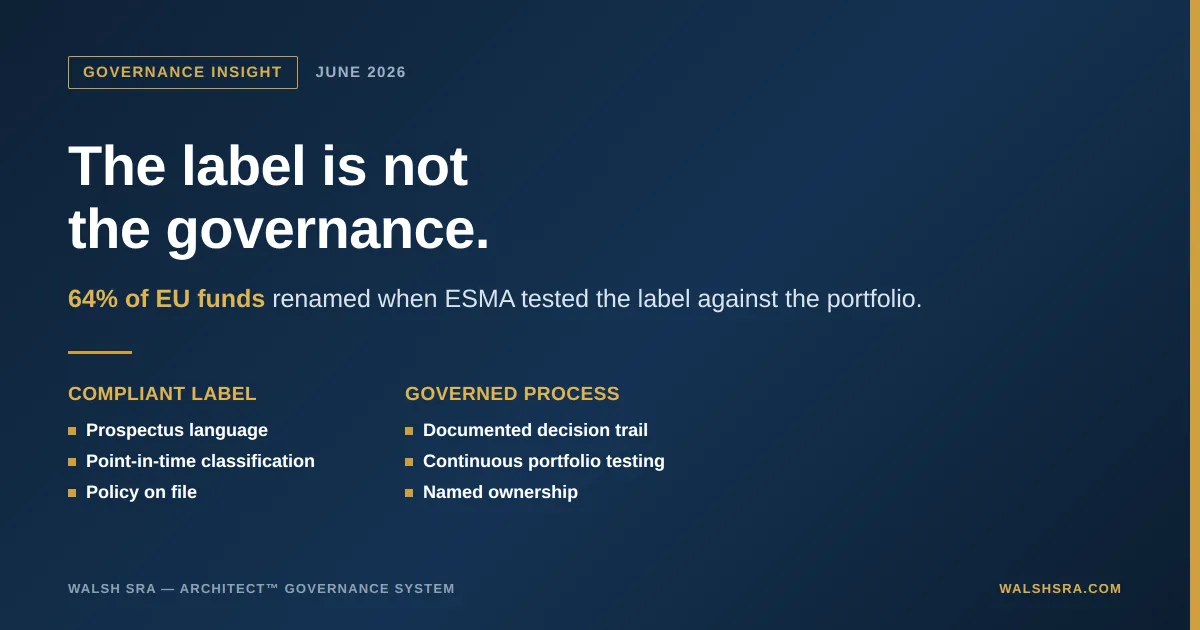
In May 2024, the European Securities and Markets Authority finalised guidelines on the use of ESG and sustainability related terms in fund names, with a compliance deadline of May 2025. The result was not a modest tidy up. Among nearly a thousand funds run by the twenty five largest EU asset managers, controlling more than seven trillion euros in combined assets, roughly 64 percent changed their names. Of the funds that dropped ESG language, 61 percent removed sustainability terminology from their name entirely rather than tighten their strategy to keep it. More than half of the sampled funds restructured their investment policy at the same time, mostly by adding explicit fossil fuel exclusions.
Read that result carefully, because it is the clearest evidence available of where the real gap sits. When a regulator asked the market to defend its fund names against the underlying portfolio, the majority response was not to defend the name. It was to remove it. That is not a data problem or a disclosure problem. It is a governance problem, made visible at scale, in public, in a single compliance cycle.
A regulatory map that is diverging, not converging
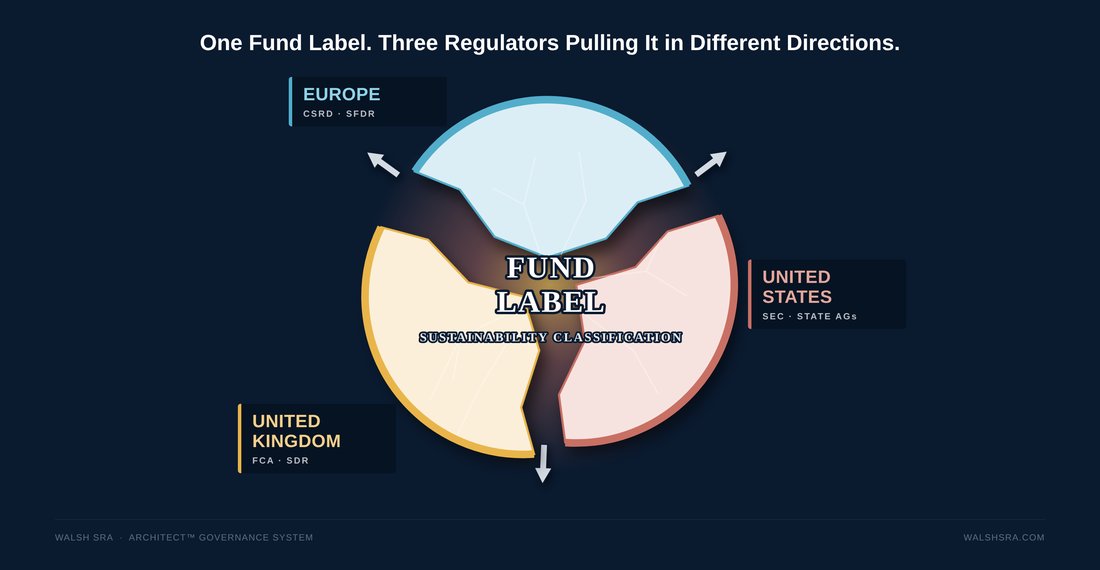
The pressure is not moving in one direction, and that divergence is itself now a governance issue for any mid-tier manager operating across more than one jurisdiction.
In Europe, the direction is toward more structure, not less, even as Brussels works to simplify the wider sustainability reporting framework. SFDR 2.0, the reform of the current fund disclosure regime, is moving through the legislative process during 2026, and is expected to replace the current Article 8 and Article 9 classifications with a voluntary three category structure built around Transition, Sustainable, and ESG Basics labels, each anchored to a minimum investment threshold. The reform is not expected to apply before 2028 or 2029, which means the current SFDR regime, and the ESMA naming guidelines already tested against it, remain the live standard for every fund a mid-tier manager runs today. Firms waiting for SFDR 2.0 to settle before investing in governance discipline are waiting for a standard that will not arrive for two or three years, while being judged against the one that already exists.
In the UK, the FCA's Sustainability Disclosure Requirements regime, its four investment labels, and its anti-greenwashing rule have been in force since 2024, with the labelling and naming rules extended by consultation to portfolio management services as well as authorised funds. For 2026, the FCA has named the anti-greenwashing rule as an area of heightened supervisory and enforcement focus, and expects firms marketing anything as sustainable to show, not just assert, that the claim is supported by evidence. The direction of travel is toward closer scrutiny, not a lighter touch.
In the United States, the picture has reversed. The Securities and Exchange Commission under its current leadership is reviewing the 2023 Names Rule amendments that extended the 80 percent investment policy test to ESG labelled funds, has disbanded its Climate and ESG Task Force, and has pushed compliance deadlines back to 2026 and 2027. The stated goal is reducing what the agency now regards as an unnecessary reporting burden.
None of that removes the underlying obligation. A fund name that misleads investors about what the fund actually holds remains a securities law problem in the United States regardless of what happens to the Names Rule's compliance calendar, and enforcement risk does not disappear just because a regulator's rulemaking ambition has cooled.
For a mid-tier manager running a UCITS range into Europe, an SDR labelled range into the UK, and a US registered fund complex at the same time, this divergence is not background noise. It means three different regulatory postures, moving in three different directions, applied to funds that may share research, security selection, and stewardship processes underneath. A governance model built for one jurisdiction's rules will not automatically satisfy another's, and a firm that has not reconciled the three is carrying regulatory risk it has not actually mapped.
Where the gap actually sits in mid-tier managers
Large global asset managers have built dedicated ESG integration teams, proprietary scoring models, and formal committees that sit between research and portfolio construction. Mid-tier managers face many of the same expectations without the same infrastructure, and that gap tends to resolve itself in a predictable way.
Sustainability ends up owned by a specialist function, a Head of ESG, a stewardship team, a product governance committee, that sits outside the investment process rather than inside it. That function writes the disclosure, selects the data provider, and defends the label to compliance and to clients. What it frequently does not have is a formal, evidenced line back into the portfolio manager's actual buy, sell, and engagement decisions.
That separation is not a data failure. Most mid-tier managers now have perfectly adequate ESG data feeds and scoring tools. It is a governance failure, because the label makes a claim about the portfolio, and the process that would prove the claim, the one connecting a PAI indicator or an engagement outcome to a specific investment decision, sits in a different part of the organisation from the process that actually makes investment decisions.
Where governance really lives: the investment process, not the prospectus
The prospectus and the pre contractual disclosure describe what a fund intends to do. They are not evidence that it does it. That evidence, if it exists at all, lives inside the investment process itself.
Can a Chief Investment Officer or Head of Stewardship show how a specific principal adverse impact indicator, a carbon intensity threshold, a controversy flag, a poor engagement outcome, changed a position size, triggered an exclusion, or escalated a proxy vote against management, with a documented record of the decision and who made it? Can the firm show that the fund's holdings were tested against its own label criteria on a continuous basis, not only at launch and at the annual review? Is there a named individual accountable for defending that specific fund's name if a regulator, a client, or a journalist asks the question ESMA already asked of the whole EU market in 2024?
Where the honest answer is no, the fund has a compliant prospectus sitting on top of an ungoverned portfolio. That gap does not stay hidden. It surfaces exactly the way it did across a thousand EU funds: quietly, at a compliance deadline, in the form of a name that could not be defended and was removed instead.
What this looks like in practice
Take a mid-tier manager running a European equities fund labelled under Article 8, screening out the weakest sustainability performers, engaging portfolio companies on climate strategy, and reporting the standard set of principal adverse impact indicators each year.
On paper, the fund looks well governed. The disclosure is complete. The data provider is credible. The annual stewardship report reads well.
Then a large institutional client, running its own due diligence ahead of a mandate renewal, asks a narrower question. Which specific holding, in the last twelve months, was reduced, excluded, or the subject of an escalated engagement because of a PAI indicator, and where is that decision documented. The compliance team can point to the fund's overall exclusion policy. It cannot point to a single decision record connecting a specific PAI breach to a specific portfolio action, because that connection was never captured as a formal step in the investment process. It happened, if it happened at all, informally, in a conversation between the ESG analyst and the portfolio manager that nobody wrote down.
That is not a hypothetical. It is the exact test the ESMA guidelines applied to the whole EU fund market in 2025, and it is the same test an institutional client's operational due diligence team, a fund platform's greenwashing screen, or a supervisor's thematic review will apply to an individual fund at any point after that.
Why this becomes a distribution and mandate issue
For an asset manager, a governance gap on sustainability does not stay confined to a compliance file. It moves directly into distribution.
Institutional clients, pension funds, insurers, and sovereign wealth funds now routinely ask for governance evidence rather than policy documents as part of manager due diligence, mirroring the shift already under way in private equity and insurance due diligence. Fund platforms and wealth management gatekeepers run their own greenwashing screens before agreeing to distribute a fund, and a mismatch between a fund's name and its documented process is precisely what those screens are built to catch. A fund forced to rename under regulatory pressure, as roughly two thirds of large EU managers' ESG labelled funds were in 2025, sends a visible signal to every client watching, whether or not any wrongdoing is found.
The commercial consequence is not abstract. Renaming a fund disrupts its marketing history, its track record presentation, and in some cases its eligibility for institutional mandates that specify a label. Losing a label reopens a due diligence process a manager thought was closed. And a manager that cannot answer a sophisticated client's governance questions on one fund invites the same question about every other fund in its range.
The ARCHITECT™ lens for asset managers
The ARCHITECT™ Governance System was built to answer one question across every sector it has been applied to: can a firm evidence that a financially material risk is governed, or only that it is acknowledged. Applied to asset management, the six pillars translate directly.
Accountability asks who, by name, owns the defensibility of each fund's label and sustainability claims, distinct from whoever originally drafted the prospectus disclosure. Risk Integration asks whether sustainability criteria are embedded into research, portfolio construction, and stewardship escalation, or run as a parallel screening layer that the investment team can route around. Capital Exposure, in an asset management context, means the assets under management and revenue at risk from a forced rename, a lost mandate, or a distribution platform's decision to pull a fund, translated into commercial terms a board understands. Horizon Scanning means tracking SFDR 2.0, the FCA's expanding SDR perimeter, and the SEC's shifting posture across every jurisdiction the firm actually distributes into, not just the one where it is headquartered. Information and Reporting asks whether the investment committee receives reporting that connects label criteria to live portfolio holdings, or only an annual compliance summary. Transparency and Defensibility asks whether the firm can produce, on request, a documented trail showing how a specific exclusion, engagement, or voting decision was made and by whom.
Mid-tier managers need to stop hiding behind “we follow the rules”
Compliance with SFDR's classification rules, the FCA's labelling regime, or the SEC's Names Rule is not the same thing as governance. Those regimes set a disclosure floor. Governance is the separate, harder discipline of evidencing that the investment process underneath the disclosure actually does what the label claims, continuously, not just at the moment the fund launched.
Being mid-tier does not lower that standard. It simply means the firm has less capacity to absorb the cost when the gap is found, whether that cost shows up as a forced rename, a failed platform screen, or a client that quietly does not renew.
Five questions before the next investment committee
Before the next investment committee or product governance meeting, five direct questions are worth putting on the agenda.
Named ownership. Who, by name, owns the ongoing defensibility of each fund's sustainability label, separate from whoever wrote the original disclosure documents?
Documented linkage. Could we show a specific portfolio decision, an exclusion, a reduced position, an escalated engagement, a vote against management, that was made because of a sustainability indicator, with a documented record of who made it and why?
Continuous testing. Is label compliance tested continuously against the live portfolio, or only at launch and at the annual review?
Cross-jurisdiction consistency. If our fund range spans SFDR, the UK's SDR labels, and the US Names Rule, do we have one governance process that reconciles all three, or three separate compliance exercises that have never been checked against each other?
Client-ready evidence. If an institutional client's due diligence team, or a platform's greenwashing screen, asked for our governance evidence tomorrow, would we be confident in what we handed over?
If those questions produce hesitation, the governance gap is already there.
Closing
The market has already shown what happens when a fund's name is tested against its governance and the governance is not there. Two thirds of the EU's largest managers found out in a single compliance cycle, and most of them chose to remove the name rather than defend it. The firms that will hold up the next time that test is applied, by a regulator, a client, or a platform, are the ones building the evidenced connection between label and process now, before the question is asked. The ones that wait will be having the same conversation ESMA already had with the rest of the market, just later, and with their own name on the line.
Not sure whether your fund range could survive the same test ESMA applied to the EU market in 2025? The ARCHITECT™ Governance Maturity Assessment gives mid-tier asset managers a structured diagnostic over two to three weeks, showing where label and governance are aligned, where they are not, and what to fix before a client or a regulator asks first.
Start the ARCHITECT™ Governance Maturity Assessment →
Sources
Author bio
Brendan Walsh is the founder of Walsh SRA and creator of the ARCHITECT™ Governance System. He brings more than 30 years of global executive leadership at American Express across the US, Europe and Asia, including as Chairman of American Express Services Europe and American Express Bank Russia. He has served as a Board Advisor to OFGEM, the UK energy regulator, and as a Board Member of the ECB's Euro Retail Payments Board. He holds a Master's in Sustainability from Harvard and GARP certifications in Sustainability & Climate Risk and AI Risk. Walsh SRA advises mid-tier banks, insurers, asset managers and private equity firms on governance for climate, sustainability and AI risk.
