From Awareness to Architecture: The Private Equity Mandate
Why Governance Integration Is the Next Valuation Lever
Most serious mid-market PE firms have stopped debating whether climate and sustainability risk matters. The question now is whether they can prove they are governing it.
The shift is structural, not cyclical. Limited partners and regulators have moved past policy statements and roadmap disclosures. They are looking for evidence of integrated governance — documented, repeatable oversight that connects GP-level commitments to portfolio company execution and can survive rigorous due diligence or regulatory examination.
For mid-market PE firms, this creates a specific and pressing challenge. The governance infrastructure that satisfies a Tier-1 institutional LP or a European regulator today is not the same as having a well-crafted ESG policy. It requires architecture — a structured, defensible governance model that operates consistently across a diverse portfolio and holds up under scrutiny at every stage of the investment cycle.
In 2022, I wrote about the pivotal role Private Equity plays in the climate transition and the materiality of climate risk for GPs and their portfolios. The market has moved significantly since then. What was emerging in 2022 is now expected. This article is about what that expectation requires in practice.
The Regulatory and LP Landscape Has Shifted
The governance expectation is not informal. It has been codified across multiple frameworks that directly affect mid-market PE firms.
The EU's Sustainable Finance Disclosure Regulation (SFDR) requires PE firms operating in or raising capital from European markets to classify and disclose how sustainability risks are integrated into investment decisions. This is not a disclosure exercise — it is a governance requirement. A firm that cannot demonstrate how sustainability risk is assessed, owned, and managed at portfolio level is structurally exposed under SFDR.
The Institutional Limited Partners Association has made clear in its due diligence guidance and ESG assessment frameworks that LPs expect evidence of governance integration — not policy statements — as a condition of sustained institutional confidence. The ILPA ESG Assessment Framework explicitly addresses how GPs demonstrate governance capability across the investment lifecycle.
The PRI's annual signatory reporting consistently shows that while the majority of PE signatories have adopted ESG policies at the GP level, the proportion with integrated governance frameworks connecting GP oversight to portfolio company risk management remains significantly lower. The gap between policy adoption and governance integration is the defining challenge of the current phase.
For mid-market firms raising capital from institutional LPs, accessing European markets, or preparing portfolio companies for exit to regulated buyers, these are not abstract requirements. They are commercial realities.
The Portfolio Governance Gap
Private equity's unique strength — control and influence over portfolio companies — is also its greatest governance burden.
A PE firm may have a well-crafted ESG policy at the GP level. That policy may be articulated in the fund documents, referenced in LP communications, and reflected in investment criteria. Yet in many mid-market firms, that policy fails to connect with the governance and risk management frameworks of the underlying portfolio companies. The GP-level commitment does not translate into portfolio-level execution.
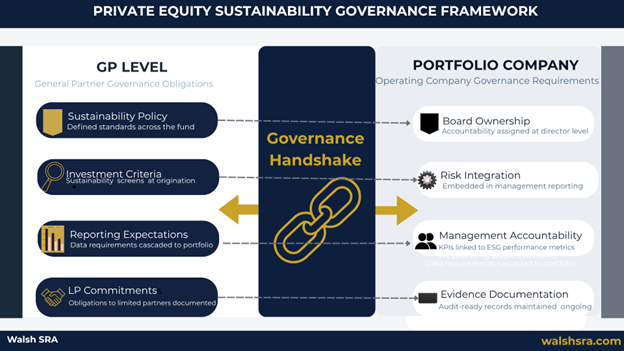
PE Sustainability Governance Framework
This creates a governance exposure — a structural gap between stated commitment and demonstrated oversight. It is a gap that is increasingly visible to the buyers, lenders, and LPs who conduct diligence on PE firms and their portfolios.
The gap is widely recognized across the industry. A GP's fund documents may articulate strong sustainability commitments, its annual report may include extensive ESG narrative, and its investment team may speak fluently about climate risk — yet the Board papers of its portfolio companies contain no documented challenge on a single climate-related governance decision. Policy quality and governance quality are not the same thing. The most sophisticated market participants have learned to look for the difference.
The structural reason for this gap is well understood. Many mid-market portfolio holdings — particularly in the lower and core mid-market — are owner-managed or operationally focused businesses that rarely have the internal expertise or governance infrastructure to integrate climate and sustainability risk into their risk management frameworks. The challenge of bridging this gap falls to the GP. Without a structured approach, sustainability risk sits in organizational limbo: discussed at acquisition, absent from the post-close governance cycle, and rediscovered — often under pressure — during exit preparation.
Where Governance Integration Should Appear
For PE firms, governance is not an abstraction. It becomes real — and its absence becomes visible — at specific decision points across the investment lifecycle.
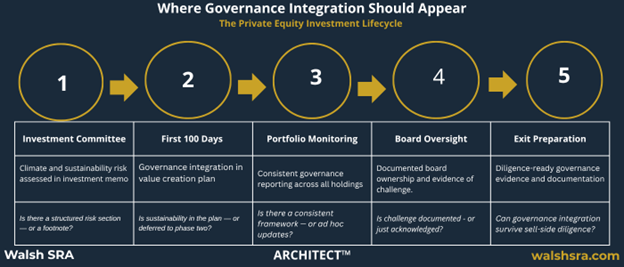
PE Deal Lifecycle Governance
Investment Committee
How does climate and sustainability-related risk appear in the investment memo? Is there a structured risk section that addresses governance maturity, transition exposure, and regulatory readiness — or is sustainability a footnote to the financial analysis? For firms raising capital from institutional LPs or targeting European exits, the investment committee is where governance integration must begin.
First 100 Days
Does the post-acquisition value creation plan include governance integration milestones? Or does sustainability remain a "phase two" topic that never arrives? The first 100 days establish the operating rhythm for the hold period. If governance integration is not in the value creation plan at this stage, it is unlikely to be systematically addressed during ownership.
Portfolio Monitoring
Do operating partner reviews include governance maturity? Is there a consistent framework for assessing and reporting on climate and sustainability-related governance across the portfolio? Inconsistent portfolio monitoring is one of the most common governance weaknesses identified in GP-level due diligence.
Board Oversight
Do portfolio company boards have clear, documented ownership of climate and sustainability-related risk? Is there evidence of board-level challenge — not just awareness? A board that acknowledges risk without a structured oversight process does not have governance. It has disclosure.
Exit Preparation
Can the firm demonstrate governance integration to a buyer, lender, or insurer conducting sell-side diligence? What evidence exists? Governance gaps discovered at exit are among the most commercially damaging — they arrive at the moment of maximum valuation sensitivity and minimum time to remediate.
If governance integration does not show up at these decision points, it is not shaping outcomes where it counts.
The ARCHITECT™ Governance System
Effective sustainability governance in a PE context is not a parallel workstream or an annual reporting exercise. It is a structured operating model that connects GP oversight to portfolio execution across the investment lifecycle.
Walsh SRA developed the ARCHITECT™ Governance System to help firms move from policy to architecture. For Private Equity, the six pillars translate into specific, deal-cycle-relevant governance requirements.
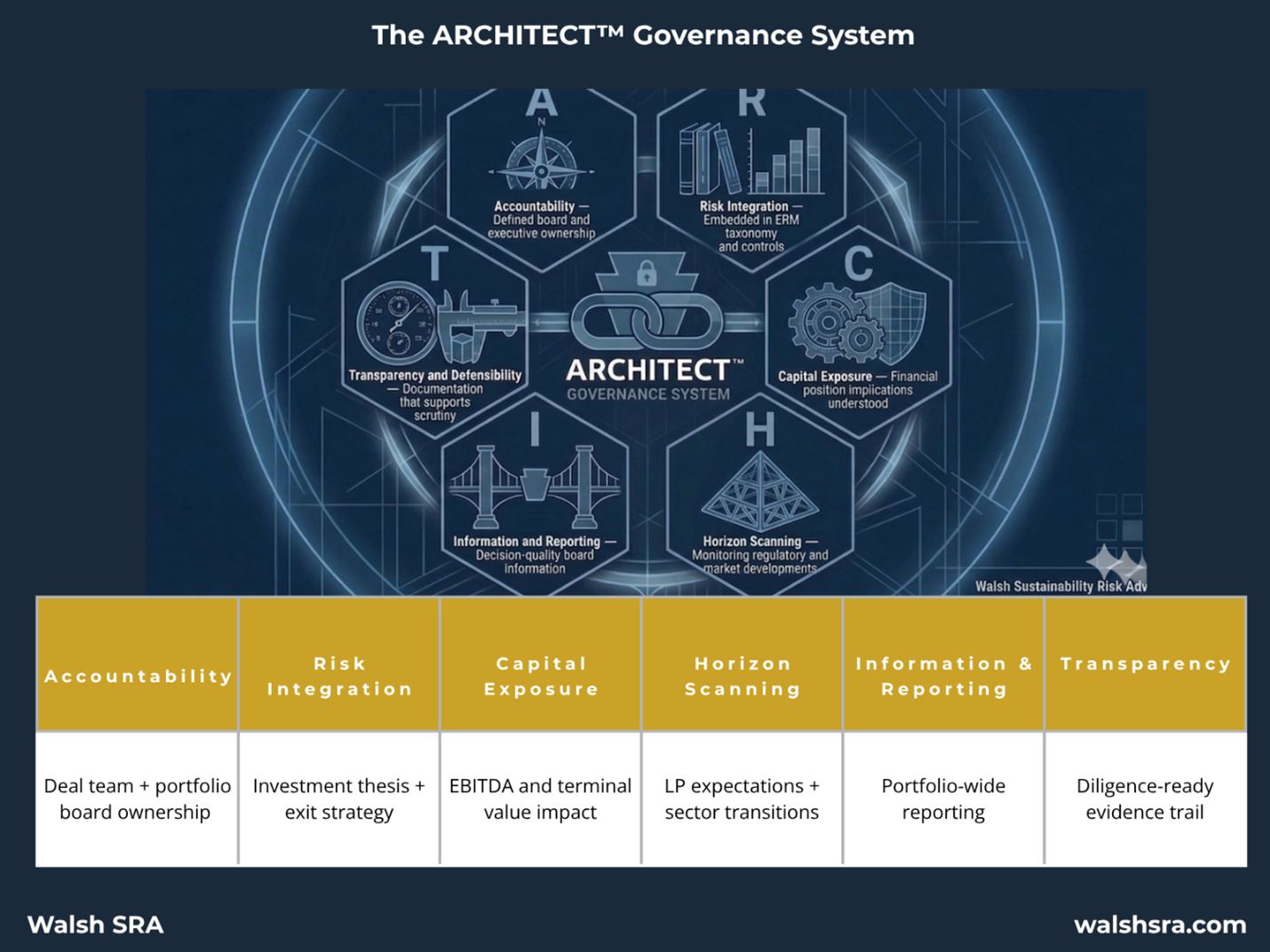
The ARCHITECT™ Governance System — Walsh SRA's methodology for evaluating governance maturity for climate and sustainability-related financial risk.
A — Accountability
Moving beyond a GP-level sustainability lead to ensuring that Deal Teams, Operating Partners, and Portfolio Company Boards have specific, documented risk ownership with defined escalation paths. Accountability must be named, not assumed — and it must exist at both GP and portfolio level.
R — Risk Integration
Standardizing how climate and transition risks are assessed and integrated across the portfolio — not just at entry diligence, but throughout the hold period and into exit strategy. This means embedding sustainability risk into the investment framework, not treating it as a parallel assessment.
C — Capital Exposure
Understanding how governance maturity — or its absence — affects financial performance and exit outcomes. This includes EBITDA implications from operational transition risk, the effect of governance gaps on insurability and financing conditions, and the valuation impact of weak documentation under buyer or lender diligence.
H — Horizon Scanning
A structured process to monitor LP expectations, regulatory developments, and sector-specific transition pressures across the portfolio. The goal is anticipating what buyers, lenders, and regulators will require at exit — not discovering it during sell-side preparation.
I — Information and Reporting
Creating consistent, decision-useful governance reporting across the portfolio that supports GP oversight, operating partner engagement, and LP transparency. This means moving beyond annual ESG questionnaires toward reporting that reflects actual governance activity and oversight quality.
T — Transparency and Defensibility
Building the documentation that connects GP policy to portfolio company execution — the evidence trail that demonstrates governance is functioning, not merely stated. This is what survives buyer, lender, and LP diligence. Under scrutiny, undocumented governance is indistinguishable from absent governance.
Governance Architecture as a Valuation Lever
Governance architecture is becoming a valuation differentiator — and in some transaction contexts, a valuation prerequisite.
The commercial consequences of governance weakness in PE are specific and increasingly direct.
At entry, weak governance assessment creates blind spots in the investment thesis — exposing the firm to transition risk, regulatory exposure, or operational vulnerability that was not adequately priced. At hold, governance gaps create friction in operating partner engagement, inconsistency in portfolio reporting, and missed opportunities to build the evidence base that supports exit valuation. At exit, governance weaknesses discovered by buyers, lenders, or insurers during sell-side diligence can contribute to pricing pressure, extended diligence timelines, management disruption, and reduced ability to defend assumptions.
By contrast, firms that can demonstrate disciplined governance across the portfolio are better positioned across four dimensions:
Clearer investment committee decision-making at entry, supported by structured risk assessment.
Stronger portfolio oversight during the hold period, with consistent reporting and documented challenge.
More credible value creation narratives, supported by evidence of governance integration.
Better prepared exit documentation that reduces diligence friction and supports valuation defense.
The most successful mid-market PE firms in the current environment will be those that treat sustainability governance not as a reporting obligation but as a core component of how they create, protect, and realize value.
Questions to Ask Yourself
The governance gap in PE is rarely visible from inside the firm until it surfaces in an LP review, a regulatory inquiry, or a sell-side diligence process. Before your next investment committee or portfolio review, ask:
Does our investment committee process include a structured assessment of climate and sustainability-related governance risk?
Do our post-acquisition value creation plans include governance integration milestones?
Do our portfolio company boards have documented ownership of climate and sustainability-related risks?
Is there consistent governance reporting across the portfolio that reflects actual oversight activity?
Could we demonstrate governance integration to a sophisticated buyer or LP conducting diligence today?
If the answers are unclear, the governance gap is real — and it may already be affecting value.
Download your PE Governance Checklist
If you are not certain how your governance framework would perform under LP review, regulatory examination, or sell-side diligence, the ARCHITECT™ Governance Maturity Assessment provides a structured starting point. It takes two to three weeks and produces a clear picture of where your governance stands — and where it needs to go.
Start Your Governance Maturity Assessment
Brendan Walsh is the founder of Walsh SRA and creator of the ARCHITECT™ Governance System. He brings more than 30 years of global executive leadership in regulated financial services, including senior roles at American Express spanning the US, Europe, and Asia, and advisory experience with regulated institutions including the UK's Office of Gas and Electricity Markets (OFGEM). He holds a Master's degree in Sustainability from Harvard University and is credentialed by GARP in both Sustainability and Climate Risk (SCR) and AI Risk. Walsh SRA advises mid-tier financial institutions and private equity firms on governance frameworks for climate and sustainability-related financial risk.
