Governance advisory for banks and insurers
Governance that holds when the supervisor asks.
Supervisors no longer ask whether you recognise climate or AI risk. They ask who owns it, how it sits in your Three Lines of Defence, and what evidence proves the board oversees it. Walsh SRA builds that evidence.
The depth of a global firm. The attention of a founder. A fraction of the fee.

Every engagement is led and delivered personally by Brendan Walsh: former EVP, American Express; former Board Member, ECB Euro Retail Payments Board; former Board Advisor, OFGEM; creator of the ARCHITECT™ Governance System.
European banks and insurers
Climate and ESG risk governance
For mid-tier banks from EUR 5bn to 50bn and insurers facing ECB, EBA, PRA and EIOPA scrutiny.
Smaller EU banks must apply the EBA ESG risk guidelines by 11 January 2027. Can your board show who owns ESG risk and how it reaches the risk appetite?
ARCHITECT Governance Maturity Assessment.
2 to 3 weeks, board-ready roadmap.
US banks
AI governance
For community and mid-tier banks from USD 500m to 30bn using AI their examiners and boards will ask about.
No federal rule covers your generative AI. Your examiner and your board still expect you to govern it.
Mid-tier banks:
Scoped assessment, 2 to 3 weeks.
Community banks:
Fixed-fee assessment.
35+ yearsin regulated financial services
USD 10B P&LFormer EVP, American Express
Board experienceFormer Board Member, ECB Euro Retail Payments Board; former Board Advisor, OFGEM
Harvard and GARPMaster's in Sustainability; SCR and AI Risk certified
Published thinking
Read how we think before you talk to us.
Brendan publishes the analysis that underpins every engagement: what supervisors, examiners and investors now test, and what boards need to evidence. Judge the thinking first.
European banks · EBA ESG guidelines
Seven Weeks to January
The EBA's ESG risk guidelines reach Europe's small and non-complex banks on 11 January 2027. What credible readiness looks like with seven weeks to go.
Read the article →Method · Climate and AI
The Blueprint Was Never About Climate
The ARCHITECT™ Governance System was built for climate risk. Applied to AI governance eighteen months later, it exposed the identical accountability failure.
Read the article →US banks · AI governance
No Rule Applies. The Exam Still Does.
Community banks got no relief from the 2026 model risk guidance. It excludes the generative AI they actually use, leaving the exposure entirely their own.
Read the article →The model
Why institutions choose a specialist
Each model has its place. Walsh SRA is built for one question: will your governance hold when a supervisor, examiner or investor tests it?
| Comparison | Global consultancy | Specialist ESG adviser | Walsh SRA |
|---|---|---|---|
| Who leads the work | Partner-led, team-delivered | Consultant team | Founder-led and founder-delivered, start to finish |
| Experience at the table | Varies by engagement team | Sustainability specialists | 35+ years running and governing regulated financial institutions |
| Primary focus | Broad advisory and assurance | Disclosure, ratings and reporting | Governance that holds under supervisory review |
| Method | Firm frameworks, adapted by team | Reporting standards such as CSRD and ISSB | ARCHITECT™: six pillars scored from Reactive to Scrutiny-Ready, across sustainability and AI risk |
| Time to a board-ready view | Scoped per engagement | Scoped per engagement | Two to three weeks |
| Fee structure | Time-based, scaled to team size | Time-based | Fixed fee, agreed before work starts |
| After delivery | Through the account team | Typically ends with the project | Direct line to the adviser who did the work |
Walsh SRA
Who leads the work
Founder-led and founder-delivered, start to finish
Experience at the table
35+ years running and governing regulated financial institutions
Primary focus
Governance that holds under supervisory review
Method
ARCHITECT™: six pillars scored from Reactive to Scrutiny-Ready, across sustainability and AI risk
Time to a board-ready view
Two to three weeks
Fee structure
Fixed fee, agreed before work starts
After delivery
Direct line to the adviser who did the work
Global consultancy
Who leads the work
Partner-led, team-delivered
Experience at the table
Varies by engagement team
Primary focus
Broad advisory and assurance
Method
Firm frameworks, adapted by team
Time to a board-ready view
Scoped per engagement
Fee structure
Time-based, scaled to team size
After delivery
Through the account team
Specialist ESG adviser
Who leads the work
Consultant team
Experience at the table
Sustainability specialists
Primary focus
Disclosure, ratings and reporting
Method
Reporting standards such as CSRD and ISSB
Time to a board-ready view
Scoped per engagement
Fee structure
Time-based
After delivery
Typically ends with the project
Most institutions have policies. Few have governance they can defend.
Weak governance stays invisible in normal operations. It shows when a supervisor, an examiner or an investor asks for evidence. Climate risk and AI risk now face the same test, and most mid-sized institutions fail it in the same three places.
01
No named owner
Risk sits with a sustainability team, an IT lead or a vendor, outside the formal risk hierarchy. No executive is accountable to the board, and no committee has it in its terms of reference.
02
Outside the risk framework
The risk is missing from the taxonomy, the risk appetite and the capital or liquidity assessment. Controls are untested, and the second line has never challenged it.
03
No evidence trail
The board receives updates, not decision-useful reporting. Decisions are taken but not documented, so the institution cannot prove oversight when asked.
The ARCHITECT Governance System
One discipline. Two risk domains.
Supervisors test the same governance discipline whether the risk is climate or AI. ARCHITECT measures it across six pillars and rates each from Reactive to Scrutiny-Ready.
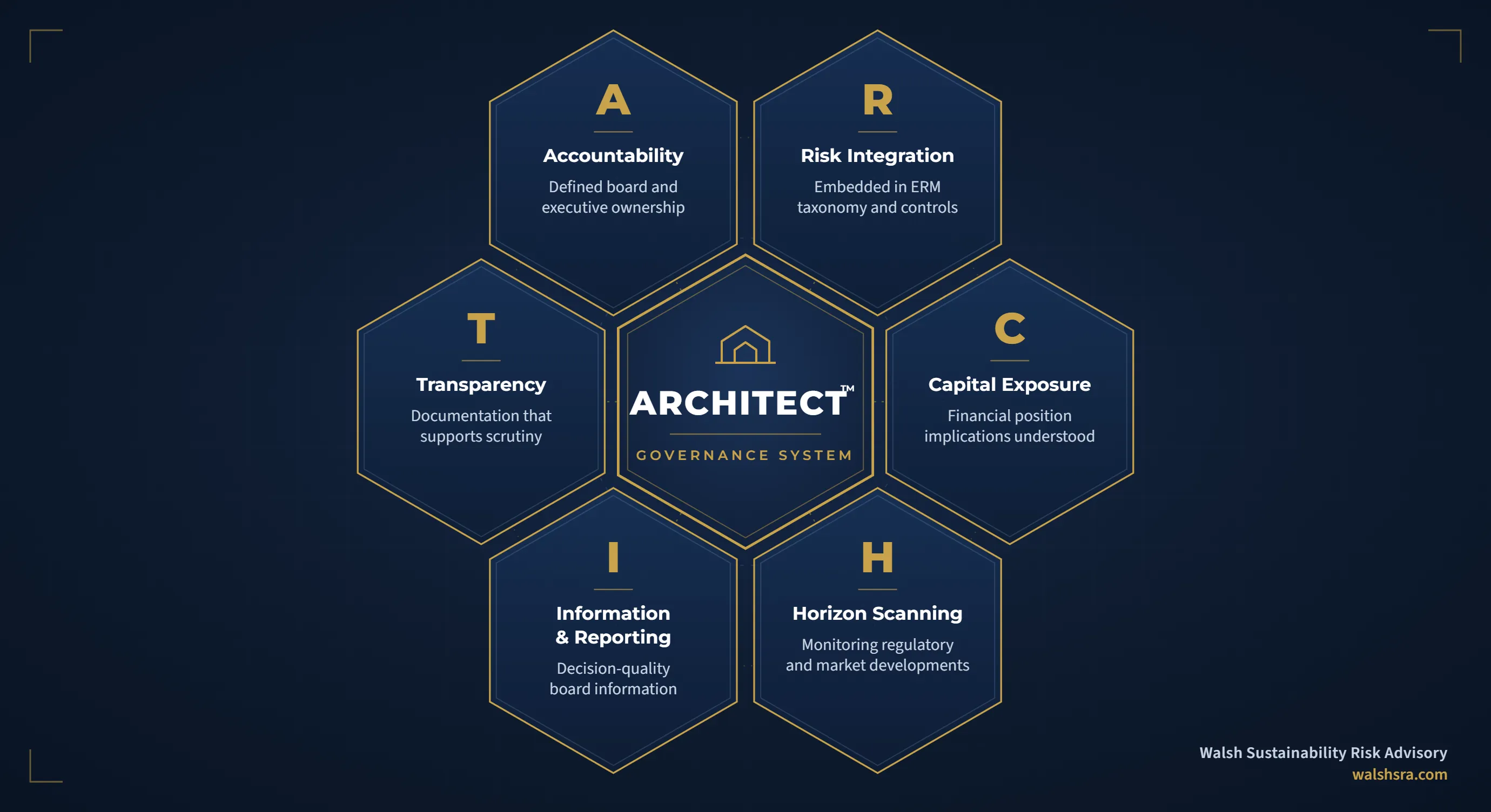
| Letter | Pillar | The question it answers |
|---|---|---|
| A | Accountability | Who owns this risk, and does the board know it? |
| R | Risk Integration | Is it in the taxonomy, the risk appetite and the controls? |
| C | Capital Exposure | Can you translate it into financial and capital impact? |
| H | Horizon Scanning | Will you see the next rule, exam or scenario before it lands? |
| I | Information & Reporting | Does the board get information it can decide on? |
| T | Transparency | Could you show a supervisor the decision trail tomorrow? |
European banks and insurers
Tier-1 supervisory expectations. Without Tier-1 infrastructure.
European supervisors have moved from guidance to enforcement on climate and ESG risk. Mid-tier institutions face the same questions as the largest banks, with a fraction of the team.
EBA ESG risk guidelines
In force for larger banks since January 2026; smaller and non-complex banks must comply by 11 January 2027. Materiality assessment, risk appetite, ICAAP and transition plans all in scope.
ECB enforcement
The ECB imposed its first periodic penalty payment for climate risk failings in November 2025, and transition planning is a 2026 to 2028 supervisory priority. National supervisors follow its lead for less significant institutions.
PRA SS5/25 and EIOPA
UK banks and insurers need board-approved climate materiality, a named senior owner and a climate risk appetite. Insurers must carry climate risk into the ORSA.
The offer
ARCHITECT Governance Maturity Assessment
Two to three weeks. Maturity scoring across all six pillars, gap analysis against ECB, EBA and PRA expectations, and a board-ready remediation roadmap.
Continues into the Climate Governance Diagnostic (4 to 6 weeks) or an advisory retainer.
Full details of the European assessment →US banks, USD 500m to 30bn
No rule applies. The exam still does.
Your bank already uses AI, in vendor products, staff tools or customer-facing models. Your examiners and your board want to know who governs it.
The federal gap
The April 2026 interagency model risk guidance is written for banks above USD 30bn and leaves generative AI out of scope.
The exam
Since September 2026, state examiners have an AI supervisory framework that reaches generative and agentic AI. Expect requests for your AI policy, inventory, risk assessments and vendor documentation.
The incident risk
In May 2026 a community bank filed a material cybersecurity disclosure after an employee used an unapproved AI tool on customer data.
Community banks, USD 500m to 10bn
ARCHITECT AI Governance Assessment for Community Banks
A fixed-fee, expert-led diagnostic: a rating from Reactive to Scrutiny-Ready on all six pillars, a 30-minute results review with Brendan, and written Recommended Next Steps sized to a community bank.
Mid-tier banks, USD 10bn to 30bn
ARCHITECT AI Governance Maturity Assessment
Two to three weeks, scoped to your AI estate: named ownership, integration into ERM, board reporting, vendor AI oversight and decision traceability. A board-ready view of what an examiner or investor would find today.
Illustrative engagements
What the work looks like
Three illustrative scenarios showing how an ARCHITECT assessment typically runs. They are examples, not accounts of specific client engagements.
Bank
Sustainability risk sat with a team outside the formal risk hierarchy, with no executive accountable to the board. A three-week Governance Maturity Assessment mapped ownership against the Three Lines of Defence, scored the gap against ECB and PRA expectations, and produced a remediation roadmap the risk committee adopted the same quarter.
Insurer
Sustainability risk appeared in disclosure reporting but not in the ORSA or capital planning. The assessment traced the gap to a missing link between the sustainability function and capital modelling, and gave the CRO a framework to bring it into the next ORSA cycle.
US bank
AI tools were in use across three vendor platforms and a staff assistant, with no inventory and no named owner. The assessment produced an AI inventory, named an accountable executive and set up quarterly board reporting ahead of the next examination.
If your supervisor asked tomorrow, could you show the evidence?
Start with an assessment. Know where you stand before someone else tells you.